

Knee Pain After 40: Causes and When to Seek Care
- Dr. Mayur Rabhadiya

- May 30
- 3 min read
Updated: Jul 28
Knee pain after 40 is common, but age alone is not a diagnosis. Changes in muscle capacity, activity, body weight, an old injury, kneecap loading or osteoarthritis may contribute. The useful question is not simply “Is this ageing?” but which structure and activity pattern explain the symptoms, and whether function is improving or declining.
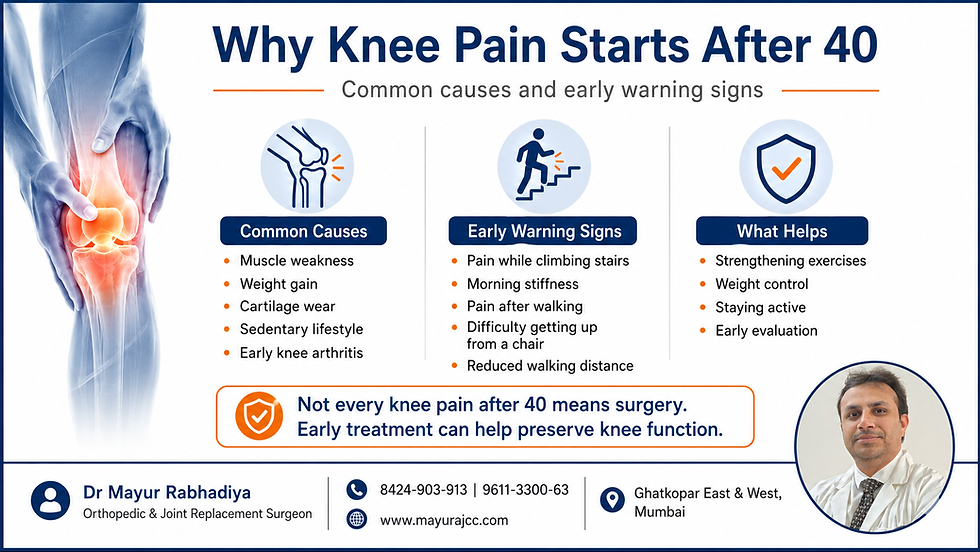
Why Knee Pain Starts After 40
The knee includes bone, cartilage, menisci, ligaments, tendons, muscles and synovium. Symptoms can begin when the demands placed on this system exceed its current capacity. That may happen after a change in activity, a period of inactivity, weight change, loss of strength or an injury that altered alignment or movement.
Osteoarthritis becomes more common with age, but it is not inevitable and it is not caused by a single “worn cartilage” process. The NIAMS overview of osteoarthritis explains that the condition can affect several joint tissues. An X-ray may help when arthritis is suspected, but symptoms, examination and function still matter.
Common Causes and Contributing Factors
Reduced quadriceps, hip or calf strength after inactivity.
A sudden increase in walking, stairs, gym work or recreational sport.
Patellofemoral overload, often noticed on stairs, slopes or after sitting.
A previous fracture, ligament injury or meniscus injury that changed knee mechanics.
Knee osteoarthritis, which may cause activity-related pain, brief stiffness, swelling or loss of movement.
Pain referred from the hip or lower back, especially when symptoms extend beyond the knee.
These factors often overlap. A person can have early arthritis and weak muscles, or an old injury plus a recent change in activity. This is why treatment should follow an assessment rather than a label based only on age.
Symptoms That Help Narrow the Cause
Location and timing provide useful clues. Pain at the front of the knee during stairs or rising from a chair may suggest increased kneecap-joint load. Joint-line pain with swelling or catching needs a different assessment. Brief morning stiffness can occur with osteoarthritis; prolonged stiffness, several swollen joints or systemic symptoms may warrant evaluation for inflammatory disease.
If stairs are the main trigger, see knee pain while climbing stairs but not walking. For a broader diagnostic pathway, the knee pain treatment page explains how history, examination and selective imaging are combined.
What an Orthopedic Assessment May Include
The exact site, onset and pattern of pain.
Walking, stair use, sleep, work and exercise limitations.
Swelling, warmth, locking, instability and range of movement.
Hip and lower-back screening when symptoms may be referred.
Strength, gait, alignment and previous injury history.
Weight-bearing X-rays when arthritis, alignment change or persistent symptoms make them useful.
MRI is not automatically the first test. It is most helpful when the result is likely to change management—for example, when symptoms and examination suggest a problem not adequately explained by standard imaging.
What Usually Helps
For many non-urgent knee problems, a progressive plan is more useful than complete rest. It may include appropriately dosed strengthening, aerobic activity, activity modification and weight management where relevant. The NICE osteoarthritis guidance recommends therapeutic exercise tailored to the person and supports weight management for people with osteoarthritis who are overweight or obese.
A sensible programme begins below the level that causes a prolonged flare, then increases gradually. Track walking tolerance, stairs, chair rise, swelling and next-day response. Pain during exercise is not the only measure; the direction of function over several weeks matters.
Learn how rehabilitation should be selected and monitored in physiotherapy for knee pain. When symptoms are clearly arthritic, the knee arthritis treatment pathway covers non-surgical and surgical decision points without assuming that every abnormal X-ray needs an operation.
When to Seek Prompt Medical Review
Seek urgent assessment for a hot, red or rapidly swollen knee, fever or feeling unwell, inability to bear weight, a major injury, an obvious deformity, or a genuinely locked knee. The NHS knee-pain guidance lists similar urgent warning signs. Persistent night pain, unexplained weight loss or progressive neurological symptoms also need timely clinical review.
The Practical Takeaway
Why knee pain starts after 40 differs from person to person. Identify the pain source, measure functional loss, exclude warning signs and use the least invasive treatment likely to help. Surgery is considered only when diagnosis, severity, disability and response to appropriate non-surgical care support it.
Medical Review and References
Medically reviewed by Dr. Mayur Rabhadiya, orthopedic and joint replacement surgeon in Mumbai. Last reviewed: 16 July 2026.
NICE NG226: Osteoarthritis in over 16s—diagnosis and management.
NIAMS: Osteoarthritis overview.
NHS: Knee pain and urgent warning signs.
This article provides general education and does not replace an individual examination or treatment plan.


