GFC Injection Full Form: Growth Factor Concentrate Explained

Updated: 7 days ago
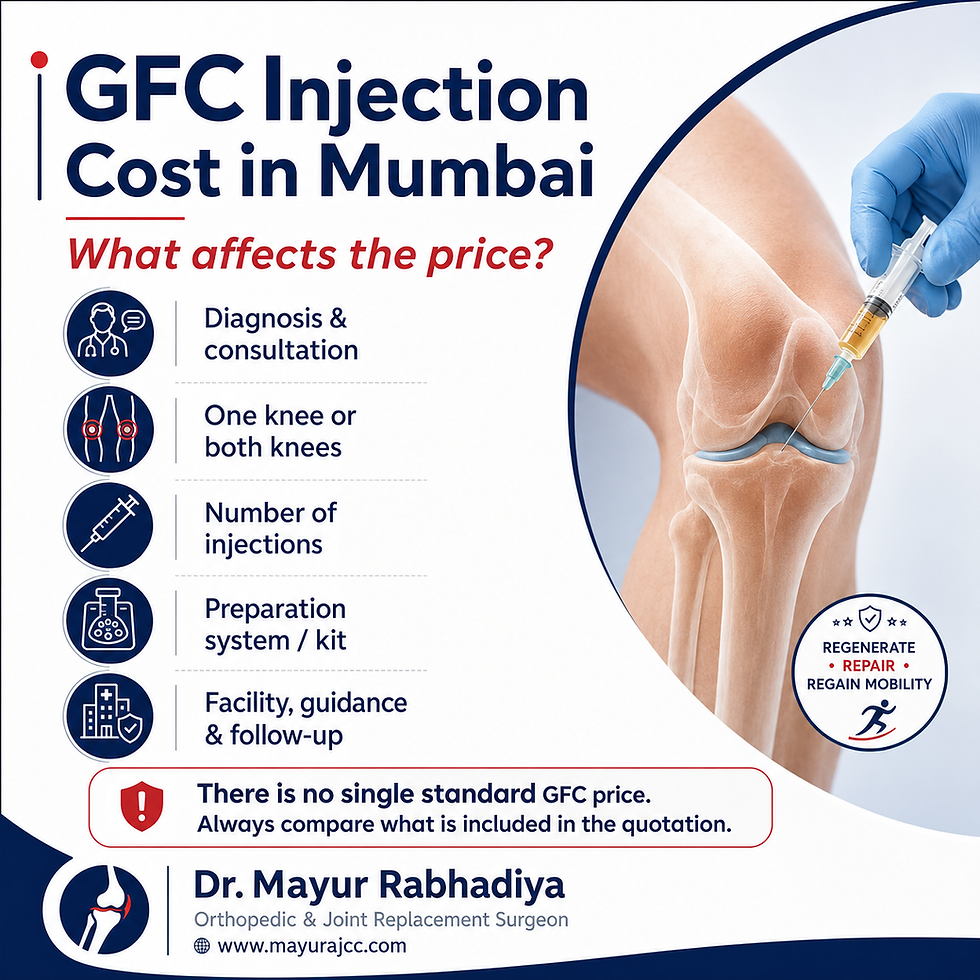
GFC injection full form is Growth Factor Concentrate, a term used for a platelet-derived preparation intended to concentrate selected growth-factor-rich components. GFC commonly refers to Growth Factor Concentrate, an autologous blood-derived preparation used as an injection for selected musculoskeletal conditions. Blood is collected from the patient, processed using a specific system, and the resulting growth-factor-containing product is injected into the target joint.
Knee pain affecting walking or stairs? Book a knee assessment in Ghatkopar with Dr. Mayur Rabhadiya to discuss the cause and whether GFC therapy or another treatment is appropriate. Call +91 84249 03913 for appointments.
GFC Injection Full Form: What the Term Means

What Is GFC Injection: Direct Answer
In orthopedic injection practice, GFC is commonly expanded as Growth Factor Concentrate. The label does not describe one universally standardised biological product. Preparation systems, cellular content, activation, concentration and injection protocols can vary.
How Is a GFC Injection Prepared?
The detailed method depends on the system used. A typical process includes:
Collecting a measured amount of the patient’s blood
Processing the sample through centrifugation or a system-specific method
Separating or concentrating platelet-derived growth-factor-containing components
Preparing a final injectable volume
Injecting the product into the selected joint using sterile technique
Patients should ask which system and protocol are being used. A brand name or the word “advanced” does not by itself establish clinical superiority.
Is GFC the Same as PRP?
GFC and platelet-rich plasma both start with autologous blood and belong to the broad group of platelet-derived orthobiologic preparations. However, they should not automatically be treated as identical.
PRP itself is an umbrella term. Preparations can differ in platelet concentration, leukocyte content, activation and dose. GFC systems may aim to concentrate or release growth factors in a different way, but composition and clinical evidence need to be considered for the specific preparation.
Read GFC versus PRP for knee arthritis for a practical comparison.
What Does the Injection Aim to Do?
The intended clinical objective is symptom modification. In selected patients with knee osteoarthritis, a blood-derived injection may reduce pain or improve function for a period of time. Response varies, and some patients obtain little or no meaningful benefit.
Growth factors participate in biological signalling, but this does not mean that an intra-articular injection reliably restores normal cartilage or reverses established osteoarthritis. Laboratory rationale and clinical outcomes are not interchangeable.
What Does Current Evidence Show?
Most clinical evidence relevant to platelet-derived injections in knee osteoarthritis concerns PRP categories. Studies report possible improvement in pain or function in some patients, but products and protocols are heterogeneous.
NICE notes no major safety concerns for PRP in knee osteoarthritis but considers efficacy evidence limited in quality. AAOS reviews also highlight variation in study methods and preparations. GFC-specific claims should not be extrapolated beyond the evidence for the actual product and protocol.
Which Conditions Is GFC Marketed For?
GFC is marketed for knee osteoarthritis and several other musculoskeletal conditions. The presence of marketing does not establish that it is appropriate for every condition. Evidence, patient selection and alternative treatment differ by diagnosis.
Dr. Mayur Rabhadiya’s use of GFC is focused on selected patients with symptomatic knee osteoarthritis after diagnosis and staging. It is not presented as a general injection for every joint-pain complaint.
Who May Be Considered for Knee Arthritis?
Consideration may be reasonable when:
Knee osteoarthritis is confirmed as the likely pain source
Symptoms remain meaningful despite appropriate core treatment
The patient understands that response is uncertain
There is no untreated diagnosis requiring different care
Medical and bleeding risks have been reviewed
The objective is symptom and function improvement rather than cartilage regrowth
Review the detailed GFC patient-selection guide.
What Can GFC Not Correct?
An injection cannot mechanically correct bow-leg or knock-knee deformity, restore a destroyed joint surface, stabilise severe ligament failure, treat infection or remove pain referred from the hip or spine. It should not be used to avoid identifying the real diagnosis.
In advanced disabling arthritis, repeated injections may offer diminishing value and should not indefinitely postpone a discussion of other options.
Possible Side Effects
Temporary pain, swelling, stiffness or bruising may occur. Infection, bleeding, injury to nearby structures and absence of benefit are also possible. Serious or escalating symptoms after injection require assessment.
How Is Response Evaluated?
Response should be evaluated using outcomes that matter to the patient, such as walking distance, stairs, sleep, chair-rise and participation in rehabilitation. A temporary change in pain does not prove structural regeneration.
The plan should state when review will occur and what will happen if improvement is inadequate or short-lived.
Questions to Ask Before Paying for GFC
What is my exact diagnosis?
What does this preparation contain?
Which processing system is being used?
Is the evidence specific to this preparation?
How many injections are proposed and why?
What improvement is realistic?
What are the side effects and alternatives?
What is the next step if it does not help?
GFC Assessment in Ghatkopar, Mumbai
Dr. Mayur Rabhadiya evaluates symptoms, function, standing radiographs, arthritis pattern, alignment, previous treatment, medical risk and expectations before discussing GFC. Consultation is available in Ghatkopar East and Ghatkopar West.
For the main clinical overview, visit GFC therapy for knee arthritis in Mumbai.
Clinical References
Written and medically reviewed by Dr. Mayur Rabhadiya. Last medically reviewed: July 2026. This article is educational and does not replace individual clinical assessment.
Author Profile
This article is authored by Dr. Mayur Rabhadiya, Orthopedic & Joint Replacement Surgeon in Mumbai. View Dr. Mayur Rabhadiya’s qualifications and clinical profile.
If structural knee osteoarthritis is advanced and injections are unlikely to meet the patient’s goals, review the knee replacement assessment and surgery guide. If robotic assistance is being considered, see the robotic knee replacement guide for what the technology can and cannot add.