
Advanced PRP and GFC Therapy for Knee and Joint Pain in Mumbai
- Dr. Mayur Rabhadiya

- Jan 23
- 6 min read
Updated: Mar 22
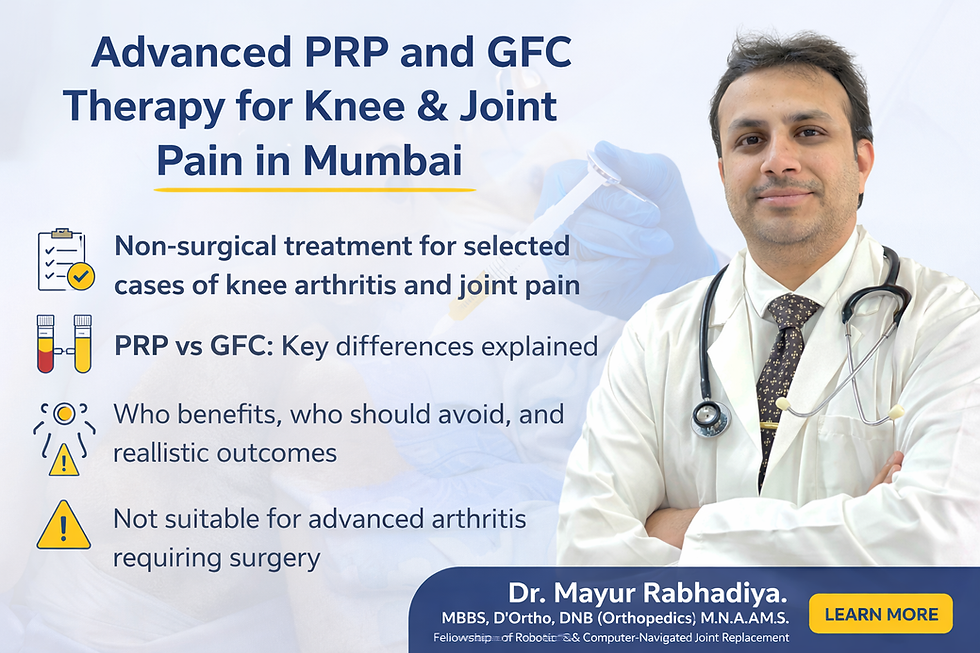
Joint pain and knee arthritis are no longer problems limited to old age. In Mumbai, it is increasingly common to see patients in their 30s, 40s, and early 50s struggling with knee pain, early arthritis, sports injuries, and activity-related joint problems. Many of these patients are not ready for surgery, yet they are also dissatisfied with temporary painkillers and repeated steroid injections.
This gap between conservative treatment and surgery is where regenerative orthopedic therapies such as PRP and GFC have gained attention. However, there is significant confusion, exaggerated claims, and poor-quality information surrounding these treatments. PRP is often marketed as a miracle cure, while GFC is frequently presented as a guaranteed alternative to knee replacement. Neither is true.
Dr. Mayur Rabhadiya, Orthopedic & Joint Replacement Surgeon explains in this article Advanced PRP and GFC Therapy for knee and joint pain in Mumbai from a scientific, clinical, and ethical orthopedic perspective. The aim is not to sell a procedure, but to help patients understand where these treatments genuinely fit, who benefits, who does not, and what outcomes can realistically be expected.
Understanding the Growing Demand for Non-Surgical Joint Pain Treatment
The rise in interest in PRP and GFC therapy is not accidental. Several real-world factors are driving this trend in Mumbai and across India:
Younger patients developing early osteoarthritis due to sedentary lifestyles, obesity, and previous sports injuries
Increased awareness of joint preservation and cartilage-saving strategies
Desire to delay or avoid surgery when medically appropriate
Better understanding that pain relief alone is not enough; patients want functional improvement
At the same time, misinformation has grown rapidly. Many clinics promote PRP and GFC without discussing limitations, proper patient selection, or evidence. This creates unrealistic expectations and, ultimately, disappointment.
What Is PRP Therapy for Knee and Joint Pain
PRP, or platelet-rich plasma therapy, is a biologic treatment derived from the patient’s own blood. After blood is drawn, it is processed using centrifugation to concentrate platelets, which contain growth factors involved in tissue healing and inflammation modulation.
How PRP Works in Orthopedics
Platelets release bioactive proteins that influence:
Inflammation control
Tissue repair signaling
Local healing environment
In orthopedic practice, PRP is used for:
Early knee osteoarthritis
Tendinopathies such as tennis elbow
Ligament injuries
Certain sports-related soft tissue injuries
PRP does not regenerate cartilage in advanced arthritis. Its primary role is symptom modification and improvement in joint environment, not structural reversal of disease.
Limitations of Conventional PRP
Not all PRP is the same. Outcomes vary due to:
Different preparation methods
Variable platelet concentration
Presence of inflammatory white blood cells
Inconsistent injection techniques
These limitations led to the development of more refined biologic options such as GFC.
What Is GFC Therapy and Why It Is Considered Advanced PRP for Knee Pain in Mumbai
GFC, or Growth Factor Concentrate therapy, is an advanced form of PRP designed to deliver a higher concentration of beneficial growth factors while reducing inflammatory components.
How GFC Differs From Standard PRP
GFC focuses on:
Isolating growth factors more selectively
Minimizing pro-inflammatory cells
Improving consistency between preparations
This makes GFC particularly useful in patients where inflammation control is as important as tissue signalling, such as early osteoarthritis and chronic joint pain.
GFC is not a different philosophy of treatment. It is an evolution of PRP, built on better understanding of platelet biology and joint inflammation.

PRP vs GFC Therapy: A Clear and Honest Comparison
Mechanism
PRP provides a mixed platelet concentrate, while GFC aims for a refined growth factor profile.
Indications
PRP is commonly used for tendons, ligaments, and mild joint issues.
GFC is often preferred for early to moderate joint degeneration where inflammation plays a major role.
Consistency
PRP outcomes vary significantly across clinics.
GFC offers more standardization when properly prepared.
Expectations
Neither PRP nor GFC cures arthritis. Both aim to:
Reduce pain
Improve function
Delay disease progression in selected cases
Who Should Not Choose Either
Patients with advanced, bone-on-bone arthritis are unlikely to benefit meaningfully and should be counselled toward definitive surgical options instead.
Who Is the Right Candidate for PRP or GFC Therapy
Patient selection is the most critical factor in determining outcomes.
Good Candidates
Early to moderate knee osteoarthritis
Younger active individuals with joint pain
Sports-related cartilage or soft tissue injuries
Patients seeking non-surgical options with realistic expectations
Poor Candidates
Advanced grade osteoarthritis
Severe deformity or instability
Inflammatory arthritis such as rheumatoid arthritis
Patients expecting permanent cures
A thorough clinical evaluation, imaging correlation, and honest discussion are mandatory before recommending any biologic treatment.
GFC Therapy for Knee Arthritis: Where It Truly Fits
GFC therapy plays a role primarily in early knee arthritis. At this stage, cartilage damage is limited, joint alignment is acceptable, and inflammation is a key driver of symptoms.
In such patients, GFC may:
Reduce pain
Improve daily function
Delay progression
It does not reverse cartilage loss. In advanced arthritis, biologic injections often delay appropriate surgery, leading to prolonged disability. Ethical practice requires recognizing this boundary clearly.
Clinical Outcomes and Realistic Expectations
Patients often ask how long results last. The honest answer is that results vary.
Typical observations include:
Gradual improvement over weeks, not days
Peak benefit at 2 to 3 months
Symptom relief lasting months to a year in selected cases
Long-term success depends on:
Weight management
Activity modification
Physiotherapy and muscle strengthening
Correction of biomechanical factors
PRP or GFC without rehabilitation is incomplete treatment.
Evidence and Current Orthopedic Consensus
Current orthopedic literature supports PRP and GFC as adjunctive treatments, not replacements for surgery. Studies show moderate benefit in pain and function for early osteoarthritis, with wide variability in outcomes.
International guidelines remain cautious due to:
Heterogeneous study designs
Differences in preparation methods
Lack of long-term structural data
This reinforces the importance of individualized patient counselling rather than protocol-based injections.
Why Outcomes Depend on the Treating Orthopedic Surgeon
Biologic treatments are not plug-and-play injections. Outcomes depend heavily on:
Accurate diagnosis
Imaging interpretation
Proper injection technique
Understanding joint biomechanics
Treating PRP or GFC as a commodity rather than a medical procedure is one of the biggest reasons for failure.
Common Myths About PRP and GFC Therapy
Myth: PRP regrows cartilage
There is no credible evidence supporting this claim.
Myth: One injection cures arthritis
Chronic joint disease does not have instant cures.
Myth: Everyone with knee pain needs PRP
Many patients improve with simpler, less invasive measures.
Safety, Side Effects, and Ethical Considerations
PRP and GFC are autologous, meaning they come from the patient’s own blood. This reduces allergic risks. However, no procedure is risk-free.
Potential issues include:
Injection site pain
Temporary inflammation
Infection if sterile protocols are not followed
Ethical practice requires:
Transparent counseling
Avoiding overuse
Clear explanation of alternatives
Why Mumbai Patients Are Exploring Regenerative Orthopedics
Mumbai’s lifestyle, long commuting hours, fitness trends, and sports participation have created a unique patient population that seeks joint preservation rather than early surgery. When used judiciously, biologic treatments can play a valuable role in this context.
Medical Disclaimer
PRP and GFC therapy outcomes vary between individuals. These treatments are not substitutes for surgical intervention when surgery is medically indicated. A detailed orthopedic evaluation is essential before deciding on any biologic treatment.
Conclusion: A Balanced, Evidence-Based Approach to PRP and GFC Therapy
Advanced PRP and GFC therapy represent meaningful progress in regenerative orthopedics, but only when used thoughtfully. They are not miracle cures, nor are they suitable for every patient with joint pain.
When recommended ethically, based on sound clinical judgment, and combined with rehabilitation and lifestyle modification, these therapies can help selected patients manage pain, improve function, and delay disease progression.
The future of joint care lies not in selling procedures, but in personalized, evidence-based decision-making.
PRP and GFC Therapy for Knee and Joint Pain
What is PRP therapy for knee pain?
PRP therapy involves injecting platelet-rich plasma derived from the patient’s blood into the knee joint to help reduce inflammation and improve symptoms in early osteoarthritis and certain injuries.
What is GFC therapy in orthopedics?
GFC therapy for knee pain in Mumbai is an advanced biologic injection that concentrates growth factors while reducing inflammatory components, offering more consistent outcomes than conventional PRP in selected cases.
Is GFC better than PRP for knee arthritis?
GFC may be preferred in early knee arthritis due to better growth factor delivery and reduced inflammation, but it is not suitable for advanced arthritis.
Can PRP or GFC cure knee arthritis?
No. These treatments do not cure arthritis or regenerate cartilage. They are used to manage symptoms and potentially delay disease progression in selected patients.
Who should not undergo PRP or GFC therapy?
Patients with advanced, bone-on-bone arthritis, severe deformity, or inflammatory joint diseases are unlikely to benefit and should consider surgical options.
When Orthopedic Surgeons Recommend PRP or GFC
Orthopedic surgeons may recommend PRP or GFC therapy when:
Knee pain persists despite physiotherapy and medications
Imaging shows early to moderate joint degeneration
The patient is not an ideal candidate for surgery
The goal is symptom control and functional improvement
These therapies are most effective when combined with:
Weight management
Muscle strengthening
Activity modification
Key Takeaways for Patients Considering PRP or GFC Therapy
PRP and GFC are biologic treatments, not miracle cures
Results vary between individuals
Treatment success depends on diagnosis, technique, and rehabilitation
Ethical orthopedic care involves clear counselling and realistic expectations
Author
Dr Mayur Rabhadiya
Orthopedic & Joint Replacement Surgeon
MBBS, D’Ortho, DNB (Orthopedics), M.N.A.M.S
Fellowship in Robotic & Computer-Navigated Joint Replacement
Practice Locations: Ghatkopar East & West, Mumbai
Website: www.mayurajcc.com


Comments