
Advanced PRP and GFC Therapy for Knee and Joint Pain: Evidence, Biological Rationale, Clinical Protocols and Outcome Strategy by Dr. Mayur Rabhadiya
- Dr. Mayur Rabhadiya

- Feb 23
- 5 min read
Updated: Mar 21

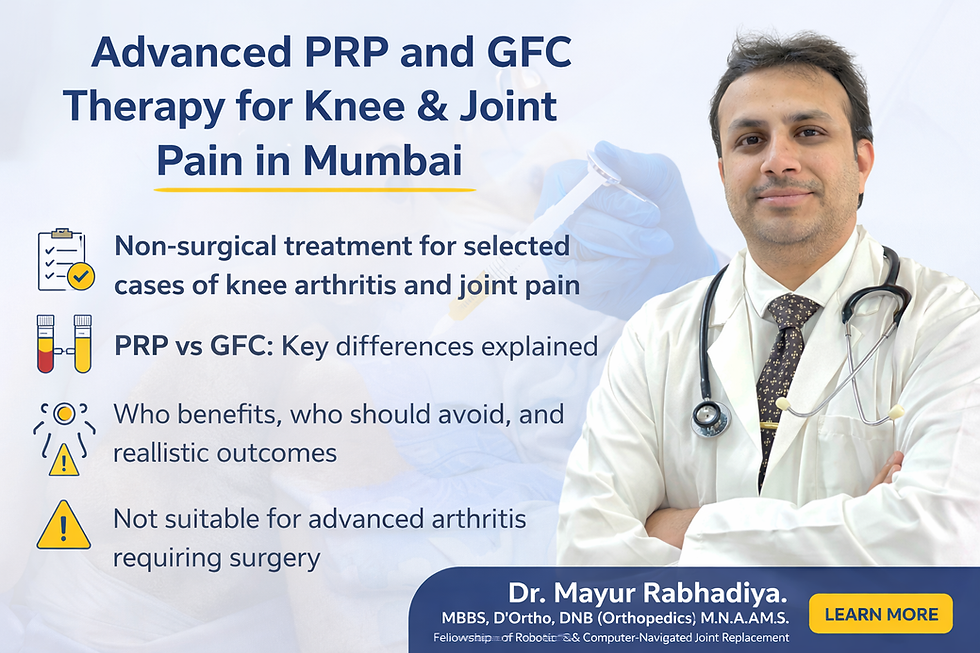
Advanced PRP and GFC Therapy for Knee and Joint Pain represents an evolving area within orthopedic practice that focuses on biologic modulation rather than simple symptomatic suppression. Over the past decade, orthobiologic injections such as Platelet-Rich Plasma and Growth Factor Concentrate have gained attention for managing early and moderate osteoarthritis and select degenerative joint conditions.
Traditional non-surgical knee pain management has relied on analgesics, physiotherapy, steroid injections, and hyaluronic acid. These methods may reduce symptoms but do not significantly influence the inflammatory microenvironment that drives joint degeneration.
Advanced PRP and GFC Therapy for Knee and Joint Pain aims to influence that biological environment in a structured, evidence-informed manner. However, outcomes depend on patient selection, mechanical evaluation, protocol precision, and realistic expectations.
I incorporate orthobiologic strategies within a broader knee preservation framework after detailed clinical evaluation, radiographic grading, and biomechanical assessment.
The Biological Basis of Advanced PRP and GFC Therapy for Knee and Joint Pain
Osteoarthritis is not simply cartilage wear. It is a biologically active disease involving:
Synovial inflammation
Cytokine-mediated cartilage degradation
Subchondral bone remodeling
Mechanical stress imbalance
Inflammatory mediators such as IL-1 beta and TNF alpha promote catabolic activity within the joint. Any intervention claiming biologic benefit must theoretically address this inflammatory cascade.
Advanced PRP and GFC Therapy for Knee and Joint Pain is based on modulating these inflammatory pathways rather than masking pain alone.
Platelet-Rich Plasma in Advanced PRP and GFC Therapy for Knee and Joint Pain
Platelet-Rich Plasma is derived from autologous blood processed through centrifugation to concentrate platelets. These platelets release growth factors including:
Platelet-derived growth factor
Transforming growth factor beta
Vascular endothelial growth factor
Insulin-like growth factor
These mediators are believed to influence synovial inflammation and cellular signalling.
Proposed Mechanisms
PRP may:
Reduce pro-inflammatory cytokines
Improve synovial fluid quality
Modulate cartilage metabolism
Enhance tissue repair signalling.
However, it is important to clarify that high-quality evidence does not confirm predictable cartilage regeneration in advanced osteoarthritis.
Clinical Evidence
Meta-analyses published in peer-reviewed journals such as the American Journal of Sports Medicine, Arthroscopy, and the Journal of Bone and Joint Surgery have demonstrated improved pain and function compared to hyaluronic acid in early to moderate osteoarthritis.
These improvements are typically seen in KL Grade 1 to 3 disease.
Outcomes in Grade 4 collapse are less predictable.
Growth Factor Concentrate in Advanced PRP and GFC Therapy for Knee and Joint Pain
Growth Factor Concentrate is derived from autologous blood, similar to PRP, but involves additional processing steps to isolate released growth mediators prior to injection.
The theoretical rationale includes:
Concentrated delivery of growth factors
Reduced cellular components
Potentially controlled inflammatory modulation
While promising, GFC has less long-term randomized data compared to PRP. Evidence remains emerging, and claims must remain proportionate to available literature.
Advanced PRP and GFC Therapy for Knee and Joint Pain should therefore be applied cautiously and selectively.
Patient Selection Criteria for Advanced PRP and GFC Therapy for Knee and Joint Pain
Correct patient selection determines outcome more than the biologic used.
Suitable Candidates
Early to moderate osteoarthritis (KL Grade 1–3)
Stable ligamentous structures
Acceptable limb alignment
Persistent pain despite conservative management
Willingness to participate in rehabilitation
Unsuitable Candidates
Advanced Grade 4 collapse
Severe varus or valgus deformity
Significant instability
Inflammatory arthritis
Unrealistic expectations of regeneration
Orthobiologics cannot correct mechanical failure. Ignoring biomechanics reduces efficacy.
Clinical Protocol Design in Advanced PRP and GFC Therapy for Knee and Joint Pain
Protocol standardization is critical.
Injection Frequency
Typically:
2 to 3 PRP injections spaced 2 to 3 weeks apart
1 to 3 GFC sessions depending on response
The number of sessions should be individualized.
Injection Accuracy
Ultrasound-guided intra-articular injection improves placement accuracy and potentially clinical outcomes.
Post-Procedure Protocol
Relative rest for 24 to 48 hours
Avoid NSAIDs peri-procedure
Structured physiotherapy focusing on quadriceps and hip stabilizers
Weight optimization where indicated
Biologic injections without rehabilitation yield suboptimal results.
Expected Outcomes of Advanced PRP and GFC Therapy for Knee and Joint Pain
Timeline
Initial improvement may begin within 3 to 6 weeks. Peak effect often occurs between 2 to 4 months. Duration of benefit varies from 6 to 18 months in selected patients.
Expected Benefits
Pain reduction
Functional improvement
Reduced reliance on analgesics
Not Guaranteed
Permanent cure
Cartilage regrowth in advanced disease
Elimination of future surgery
Realistic expectation setting is essential.
Can Advanced PRP and GFC Therapy for Knee and Joint Pain Delay Knee Replacement?
In carefully selected moderate osteoarthritis cases, orthobiologic injections may delay the need for surgical intervention.
However, in cases involving:
Severe deformity
Bone-on-bone collapse
Ligament instability
Definitive surgical correction such as robotic knee replacement surgery may provide more predictable outcomes.
More information on surgical management is available here :https://www.mayurajcc.com/robotic-knee-replacement-mumbai
Biologics should not be positioned as replacements for surgery when structural failure is advanced.
Integration With Knee Preservation Strategy
Advanced PRP and GFC Therapy for Knee and Joint Pain should form part of a broader knee preservation algorithm that includes:
Alignment evaluation
Muscle strengthening
Activity modification
Weight management
Periodic reassessment
Comprehensive information on knee arthritis management can be found here: https://www.mayurajcc.com/knee-arthritis-treatment-mumbai
Safety Profile
Because PRP and GFC are autologous:
Allergy risk is minimal
Infection risk is low with proper asepsis
Temporary inflammatory flare may occur
Contraindications include active infection, severe anaemia, platelet dysfunction, and certain systemic disorders.
Strict sterile technique is mandatory.
Frequently Asked Questions
Is PRP better than GFC?
PRP currently has stronger high-quality evidence. GFC shows promise but requires more randomized data.
How many injections are needed?
Most patients require 2 to 3 sessions, depending on disease stage and response.
Is this suitable for Grade 4 osteoarthritis?
Outcomes are unpredictable in advanced structural collapse. Surgical consultation is often appropriate.
Does this regenerate cartilage?
Current evidence does not confirm predictable cartilage regeneration in advanced osteoarthritis.
How long does relief last?
Relief may last 6 to 18 months in selected cases.
About Dr. Mayur Rabhadiya
Dr. Mayur Rabhadiya is an Orthopedic & Joint Replacement Surgeon with expertise in knee preservation strategies and robotic knee replacement surgery.
Qualifications: MBBS, D’Ortho, DNB (Orthopaedics), M.N.A.M.S.
Fellowship in Robotic & Computer-Navigated Joint Replacement
For consultation: https://www.mayurajcc.com/about-dr-mayur-rabhadiya
Phone: 8424903913 | 9611330063
Key Peer-Reviewed References
Dai WL et al. Platelet-rich plasma versus hyaluronic acid in knee osteoarthritis. Am J Sports Med. 2017.
Belk JW et al. Platelet-rich plasma versus hyaluronic acid for knee osteoarthritis. Arthroscopy. 2021.
Filardo G et al. PRP injections for cartilage degeneration. Knee Surg Sports Traumatol Arthrosc. 2015.
Campbell KA et al. Biologic injections for osteoarthritis. J Bone Joint Surg Am. 2015.
Laudy AB et al. Efficacy of PRP in knee osteoarthritis. Br J Sports Med. 2015.


Comments